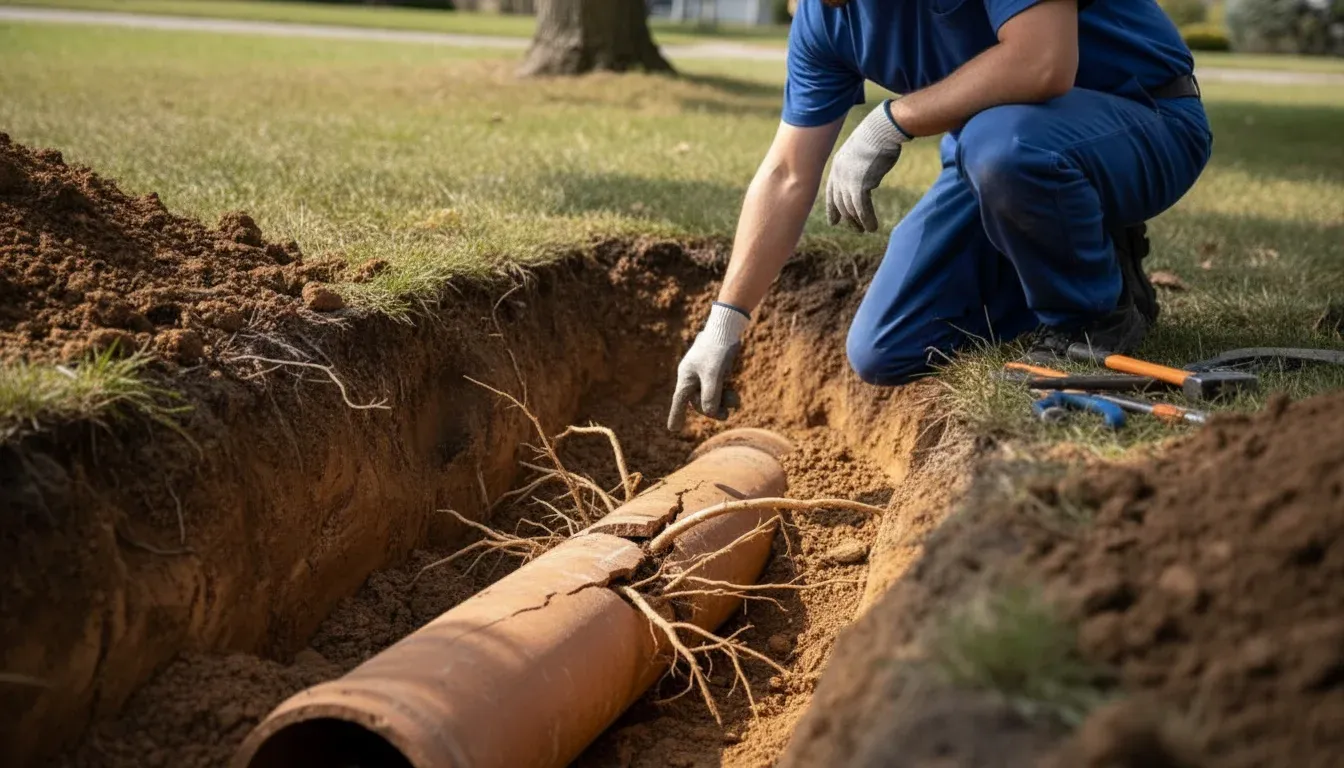


If you are wondering how to find a septic tank, start with records and observations instead of digging. A careful search can help you narrow down the likely area, but lids and pipes may be buried, landscaping can hide clues, and an old drawing may not match the system as it exists today. Use the steps below to investigate from the surface, keep people and equipment away from uncertain spots, and bring in a qualified septic professional when the location is still unclear.
Call Tommie’s Plumbing at (423) 638-3662 to discuss your plumbing concern.
Why should you locate the tank before you need access?
Knowing where the septic tank is can make future maintenance, an inspection, or a repair easier to plan. It can also help you avoid accidentally placing a shed, a heavy vehicle, a new patio, or other work over an area that may need access. If there is a plumbing backup or another urgent concern, a known location can make it easier to explain the property layout to a qualified professional.
Finding a tank is not the same as evaluating the septic system. A visible lid does not tell you whether the tank, pipes, or other system components are working properly. Likewise, a slow drain inside the house does not by itself prove that the tank is full or identify where it is buried. Treat the search as a way to locate a possible access point, not as a diagnosis.
There is no single yard pattern that fits every home. The location can depend on the original site plan, the home’s layout, later additions, repairs, and changes to the yard. Some properties have records or visible clues; others require a professional to trace the system. Do not assume that a tank is in the front yard, directly outside a particular room, or a fixed distance from the foundation.
How to Find Septic Tank Records Before Looking Outside
Begin with information that already exists. A few minutes spent checking paperwork can save a great deal of guesswork and reduce the temptation to dig in the wrong place.
- Property or septic-system drawings: Look through closing documents, home-improvement files, inspection paperwork, or records left by a previous owner. A drawing may show the tank, building sewer, access points, or other components. Check whether it includes measurements or fixed reference points such as a foundation corner.
- Maintenance and service paperwork: Search for past inspection, pumping, or repair records, including notes about where a service provider found an access lid. Ask previous owners or property managers whether they know the location. Their recollections can be useful clues, but compare them with written records when possible.
- Public or local records: Contact the appropriate local office to ask whether septic plans or permits are available for the property and how a homeowner can request them. Availability and record detail can vary. Do not assume that an online map or a property file will show the exact tank location.
- Older listing or inspection material: If you have a prior inspection report or real-estate listing documents, look for references to the septic system and any site sketch. Treat these as leads, not confirmation that a component remains in precisely the same location.
When you find a drawing, note its date and what it actually depicts. It could be an approximate plan, a proposed layout, or a record of only part of the system. A drawing with a scale and measurements tied to the house is generally more useful for narrowing down an area than a sketch without reference points, but either should be verified on the ground.
How do you make sense of an older plan?
Read the drawing as a record of one point in time, not as a guarantee about what is underground now. Look for a date, a scale, labels, and measurements tied to a permanent feature such as a foundation wall. A sketch that says “tank” near the back of the house may establish a general area, while a measured plan may let a professional compare the drawing with the current property. Neither is confirmation if the yard has changed or the drawing does not say whether the system was built as shown.
Check whether the document is a septic plan, a plumbing plan, a general site plan, or a hand-drawn note. Those documents may show different things. A property plan might display the building and boundary but not buried components. A service note might identify a lid but omit the route of the pipes. Write down what each record actually confirms and what remains uncertain.
When comparing a plan to the yard, use the same reference points throughout. For example, measure or estimate from a foundation corner shown on the drawing rather than switching between a fence, tree, and property line. Fences can move, trees can grow or be removed, and property boundaries are not necessarily visible on the ground. If the plan uses a scale that you do not understand, avoid converting a rough visual estimate into an exact location.
What if the house or yard has changed?
Think through major work completed since the records were made. A room addition, porch, driveway, retaining wall, grading project, or replacement landscaping may conceal a former access point or change what surface clues remain. Ask the prior owner, if available, whether any work affected the yard or drainage. Look for dated invoices or contractor notes, but do not presume that a project moved a tank simply because the yard looks different.
If more than one record gives a different location, keep both. Do not choose the one that looks most convenient and start uncovering the ground. Tell the professional about the disagreement and the date of each document. Conflicting information is itself important: it means the location has not yet been verified.
How to Find Septic Tank Clues Without Digging
After you gather records, inspect the likely area from the surface. The goal is to compare several clues, not to prove the tank location from one patch of grass or one visible pipe.
- Compare the records with the current yard. Use a measured drawing, service note, or other reliable record as your starting point. Note the date and compare its fixed reference points with the house and yard as they look today. If records disagree, keep both versions and treat the location as unverified.
- Trace the likely route from the home. A building sewer carries wastewater away from the home, so the tank may be somewhere along a route toward the rest of the septic system. A cleanout or pipe that exits the home can be a useful clue from a safe distance, but it may serve another part of the drainage system. Do not remove a cap or insert a rod.
- Look for surface changes that fit the records. A low mound, shallow depression, change in grass, disturbed soil, or visible access cover may help narrow the area. Each clue can have another explanation, including landscaping or unrelated utility work. Do not pry at, lift, or stand on a cover you cannot identify.
- Record several clues together. Write down the exact side and corner of the property, the fixed reference point, and what you actually observed. For example, note that an older sketch places the system beyond the back corner of the house and that a grade change appears in the same area. A note such as “the tank is by the fence” is too vague to guide safe work.
- Mark observations without disturbing the ground. Use a copy of the sketch or a simple drawing to record clues. If you need a temporary marker, place it on the surface away from any suspected lid or pipe. Do not put stakes into the ground, drive across the area, drag equipment over it, or clear soil to get a closer look.
Walk only where the ground appears stable, and stay away from depressions, wet areas, unstable covers, retaining walls, and paved sections over a suspected route. If a contractor needs the information for a project, give the records and observations as preliminary clues. The contractor should confirm buried components and applicable utilities before any excavation.
Which common search methods can cause problems?
When records are missing, it can be tempting to search by trial and error. Some methods can damage a tank or pipe, create a safety hazard, or send you in the wrong direction. Avoid these approaches:
- Digging a row of test holes: You could strike a buried pipe, damage a component, undermine a lid, or expose an unsafe opening. A shallow test hole is still a guess if the tank location has not been established.
- Probing the ground with a rod or shovel: A tool can puncture a pipe or contact a fragile component. Feeling resistance is not a safe way to identify a tank, and the absence of resistance does not prove the area is clear.
- Opening a lid to look inside: Keep tank lids closed. Septic tanks can contain dangerous gases and unsafe openings. Do not lean over an opening, enter a tank, or let anyone else do so. Inspection and access should be handled by qualified professionals using appropriate procedures.
- Driving or parking over a suspected area: Heavy loads can damage buried components or covers. Keep vehicles and equipment off areas where the tank or connected system might be located until the layout is known.
- Relying on a phone app, metal detector, or one visual sign: Buried tanks and access covers differ in material and depth, and electronic tools may not detect them. A result from a consumer device should not be treated as a confirmed location.
- Assuming utility markings show the septic system: A utility-location request may identify certain public or private utilities within the service’s scope, but it may not locate a septic tank or every privately owned line. Ask what will be marked, and never treat unmarked ground as safe to excavate.
If any digging is planned for construction, landscaping, or repair, first confirm the locations of both the septic components and applicable underground utilities through the proper services and qualified professionals. Utility marking and septic-system locating are not necessarily the same task. Do not start excavation just because one source has marked the property.
When is professional locating the better choice?
Ask a qualified septic professional to locate or verify the system when records are missing, contradictory, or hard to interpret; when the yard has been extensively changed; or when you need a reliable location before excavation or construction. Professional help is also the safer next step if you see a damaged or exposed cover, suspect a broken line, notice wastewater surfacing, or cannot tell whether a visible feature is a tank access point.
Before arranging a visit, describe the goal clearly. You may need the tank location identified, the access point exposed safely, the system inspected, or a suspected problem evaluated. Those are different tasks. Ask what the visit includes, whether the professional can provide a sketch or measurements, and whether any additional work would require your approval. Do not assume that locating the tank automatically includes an inspection or repair.
Share what you have already found: the age of the records, approximate property landmarks, past service notes, visible covers, and any recent changes to the yard. Tell the professional if there are plans for construction or equipment access. A clear description helps them understand the reason for the search and the information you need afterward.
If the concern is actually a plumbing backup, keep track of which fixtures are affected and when the symptoms began. A single slow fixture can point to a different issue than several fixtures draining poorly, but symptoms alone do not establish the cause. For related household drainage issues, see Tommie’s guide to common causes of clogged drainage. If a septic-system issue is suspected, a qualified provider can assess it; this guide is not a substitute for that evaluation.
What should you ask before scheduling?
When you speak with a provider, explain that you need help identifying the location of an existing septic tank, not planning a new installation. Ask whether locating is part of the work they perform, what information they need before the visit, and whether they can identify only an access point or also trace connected components. Do not assume every septic contractor uses the same process or provides the same level of documentation.
Confirm how the visit is expected to proceed and what could change the scope. Ask whether the provider expects to work from records and surface observations, whether any ground disturbance may be needed, and whether that would be discussed with you first. If you need the location for a planned project, ask whether the result will be documented in a form the other contractor can use. A verbal estimate such as “somewhere near the back” may not be precise enough for a future excavation plan.
You can also ask what the provider considers a confirmed result, how approximate measurements will be labeled, and whether the information should be checked again if later landscaping or construction changes the site. These are planning questions, not a request for a guarantee about buried conditions. The goal is to understand what the locating visit can establish and what uncertainties will remain.
Do not choose a provider based only on a promise to find a tank instantly or on a consumer-device reading. A complicated yard or missing history may require more investigation. Give the professional room to explain limitations, and do not authorize extra digging or repairs until you understand the proposed work and approve its scope.
How should you prepare for a locating visit?
A little preparation can make the visit more productive without disturbing the site:
- Collect available records. Put drawings, prior inspection or maintenance paperwork, and notes from previous owners in one place. Point out anything that may be outdated or uncertain.
- Clear only ordinary surface obstacles. If safe, move loose items such as toys or lightweight garden tools away from the likely search area. Do not remove heavy objects, cut into the ground, or move a cover.
- Describe the property changes. Mention additions, grading, paving, major landscaping, or work by previous owners that could have changed the yard or obscured earlier clues.
- Explain what decision depends on the location. Tell the provider whether you are planning routine access, an inspection, a repair assessment, or proposed excavation. Ask what documentation you should expect.
- Keep access safe. Keep children and pets away from suspected covers and work areas. Do not allow anyone to enter a tank or leave an opening unattended.
After the tank is located, keep the written measurements and any updated sketch with your home records. Note the date and who identified it. If the information is approximate, label it as approximate rather than converting it into a definite map. That small distinction can prevent a future homeowner or contractor from relying on a guess as if it were verified.
What does a confirmed location tell you;and what does it not tell you?
A professional’s location information is useful only when you understand its level of certainty. Ask whether the provider found a specific tank access point, identified a general search area, or inferred a location from records. Those results are not interchangeable. If part of the system could not be traced, ask for that limitation to be noted rather than filling the gap with an assumption.
Knowing the tank location does not establish the condition of the tank, the route or condition of every pipe, or the location of every other system component. It also does not replace utility locating before excavation. If your next step involves landscaping, an addition, a driveway, or other ground work, tell the relevant contractor which information is confirmed and what still needs to be checked. A locating note should inform planning, not be treated as blanket permission to dig anywhere nearby.
Keep a copy of any sketch, measurements, photos, and service paperwork together. Add the date, property reference points, and the name or business that provided the information. If a future project changes the site, update the file and explain that earlier measurements may no longer describe what is visible. A clear record is more useful than relying on memory years later.
What should you do if the search reveals a possible problem?
Stop the search if you encounter an open or damaged cover, sewage or unusually wet ground, a strong persistent odor, or a depression that appears unsafe. Keep people and pets clear of the area. Do not touch wastewater, climb into an opening, or try to seal or repair a tank yourself. Contact a qualified septic professional to evaluate the condition and advise on the next step.
A suspected septic concern and a household plumbing concern can overlap, but they are not interchangeable. A clogged fixture, a leak, or a drainage backup may have a plumbing cause that requires a separate diagnosis. Avoid using a guessed tank location to decide what needs repair. If a provider identifies damage, ask what was observed, what options are appropriate, and what is included in any estimate. Tommie’s article on factors that can affect septic tank repair cost explains why repair estimates depend on the problem and scope; it does not determine whether your property needs repair.
For homeowners in Northeast Tennessee, the practical approach is the same: start with whatever records are available, use surface clues only to narrow the search, and have uncertain locations verified before disturbing the ground. Do not assume that every local property has identical records or that a particular office maintains a complete plan. Ask the relevant local office what information it can provide, then confirm important details with a qualified professional.
Call Tommie’s Plumbing at (423) 638-3662 to talk through a plumbing issue.
Frequently Asked Questions
Can I locate a septic tank without digging?
Often, you can narrow down the likely area without digging by checking available plans and service records, asking a former owner, and comparing surface clues. These steps may not identify the exact tank or access lid. If certainty matters, have a qualified septic professional verify the location rather than digging or probing to test a guess.
Is the septic tank usually in front of or behind the house?
There is no dependable front-yard or backyard rule. The layout depends on the property and system, and a home addition or yard work may make old clues harder to read. Use records and multiple observations instead of assuming a direction or distance from the house.
Will a utility-locating service find my septic tank?
Not necessarily. The service may mark only the utilities included in its scope, and that may not include a private septic tank or every privately owned line. Ask what will be located and arrange separate septic-system locating when needed. Do not excavate based only on utility marks.
Should I open a septic tank lid once I find it?
No. Keep the lid closed and do not enter or lean over a tank. An opening can expose people to hazardous gases and a serious fall risk. Let a qualified professional handle access, inspection, and any work around the tank.
What if I cannot find records or visible clues?
Stop before making holes or using a probe. Contact the appropriate local office to ask whether property records may be available, and speak with a qualified septic professional about locating the system. Share the property history and your reason for needing the location so the next step can be planned safely.
A cautious search can help you gather useful clues, but only verified information should guide digging or construction. Keep records, avoid disturbing suspected components, and ask a qualified professional to resolve uncertainty before work begins.