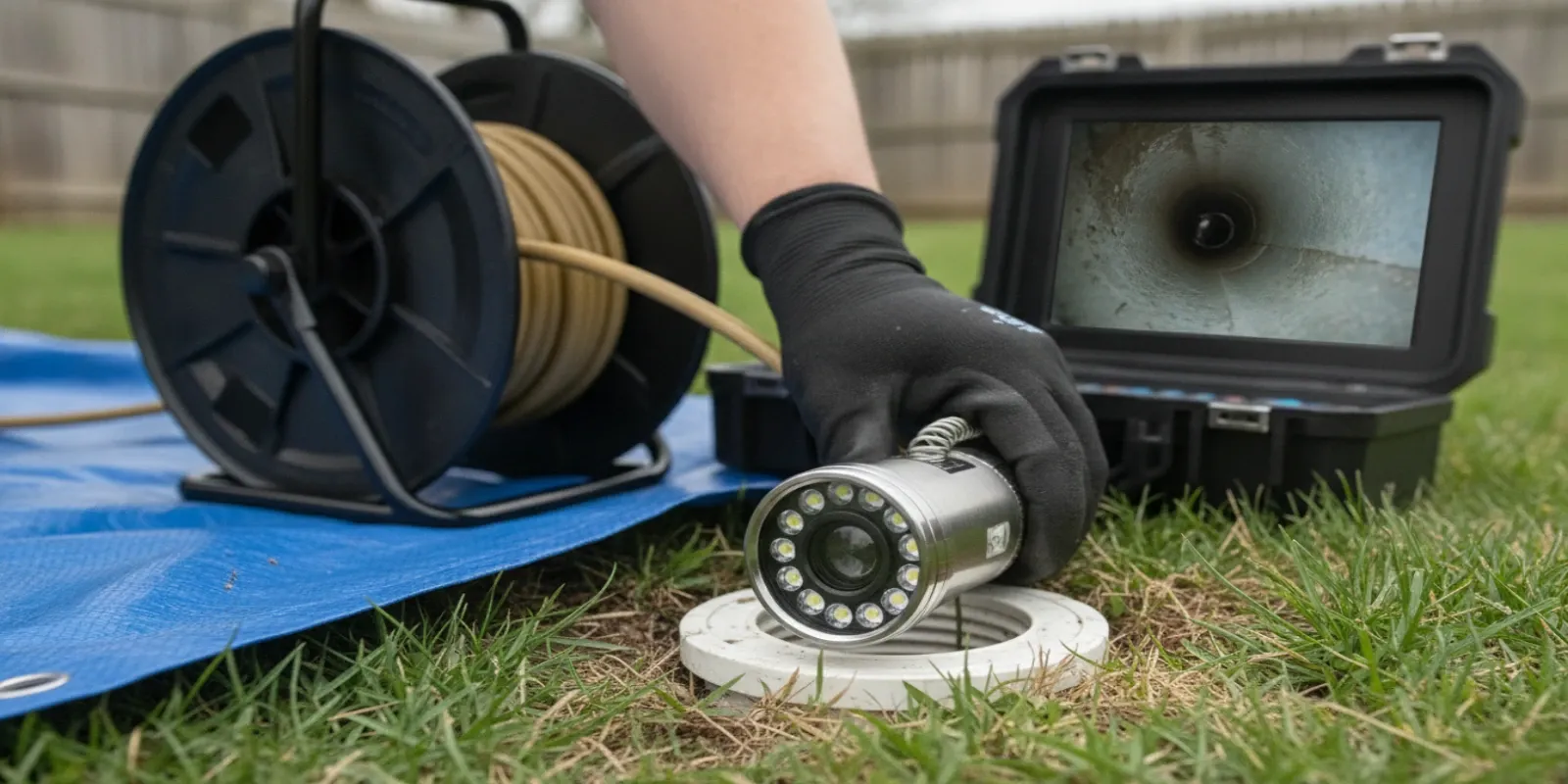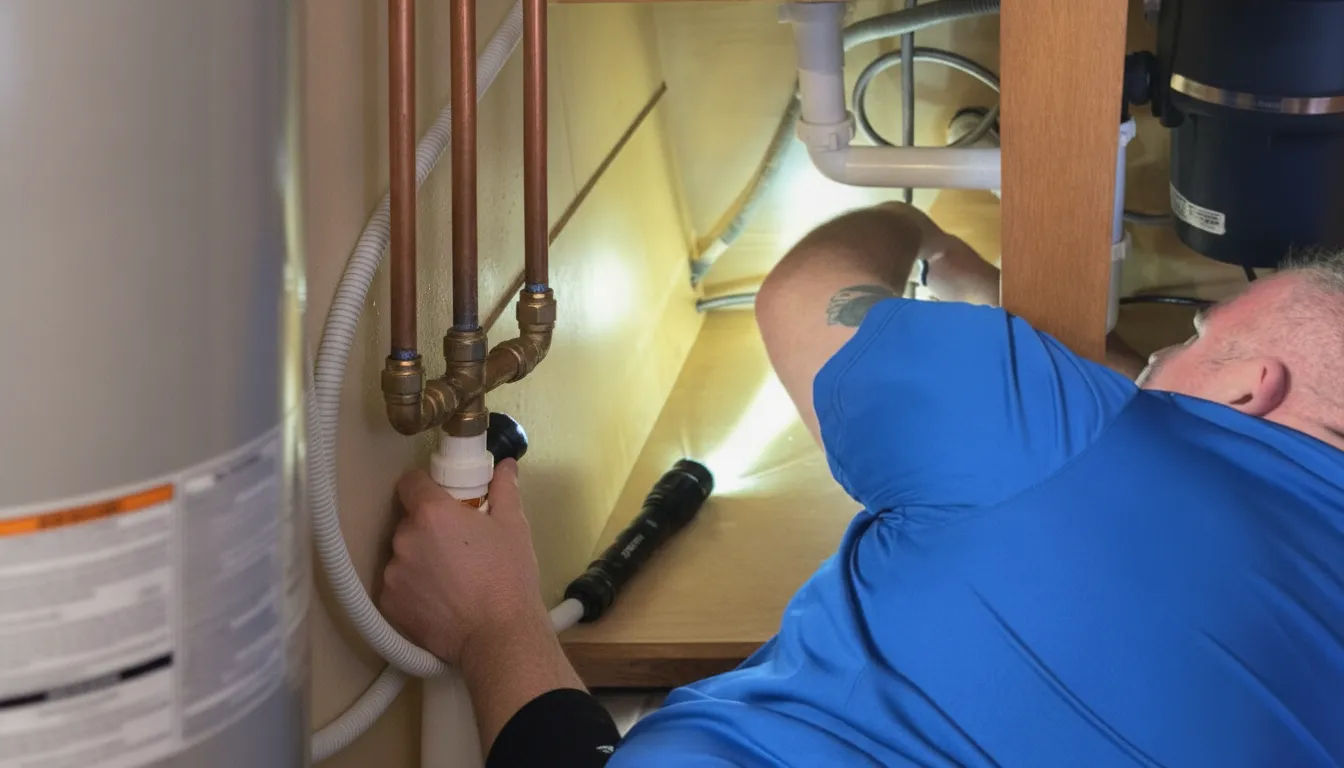


A sewer scope inspection uses a small camera to look inside an accessible section of a home’s sewer line. It can help homeowners investigate recurring drain trouble, check a line before buying a home, or understand a suspected underground problem before deciding what to do next. The camera provides a view of the pipe interior, but it does not by itself determine every cause, repair method, or cost.
Contact Tommie’s Plumbing about a sewer concern
What does a sewer scope inspection show?
A sewer scope is a visual check of a drain or sewer pipe using a flexible cable with a camera at its end. A technician feeds the camera through an accessible opening, often a cleanout, and watches the video as it moves through the pipe. Depending on access and conditions, the camera may travel along part or much of the line that carries wastewater away from the home.
The view can help identify visible conditions such as a blockage, buildup, a damaged or displaced section, roots inside the pipe, or a low spot where water and debris collect. The camera may also show that the visible portion of the pipe appears open at the time of inspection. It cannot see through a solid obstruction, examine every buried section if access is limited, or tell you everything about the soil around a pipe.
A scope is best thought of as one diagnostic tool, not a guarantee that a line will never have trouble. Its usefulness depends on getting access, the camera’s ability to pass through the line, and having someone interpret what the footage actually shows.
The difference between seeing a condition and understanding its importance matters. For example, debris visible in a pipe may be the immediate cause of slow drainage, but it may not explain why it accumulated. A camera can show an apparent opening or irregularity in the pipe wall, but the video needs context: where the camera is, what direction it is facing, whether the image is clear, and how the condition relates to your symptoms. Ask the person conducting the scope to separate direct observations from conclusions or recommendations.
When can a sewer scope be useful?
A camera check can be worth considering when symptoms point to a problem beyond one fixture or when you need more information about a buried line. It is particularly useful to discuss when:
- Several drains are slow or backing up. If more than one fixture is affected, the issue may be farther along a shared drain path than a single sink or tub trap. A scope may help locate a visible obstruction or defect after an initial assessment.
- The same blockage returns. Clearing a line can restore flow, but recurring trouble may call for investigating why it keeps happening. A camera can help distinguish a one-time obstruction from a condition that remains in the pipe.
- There are signs of a possible sewer-line issue. Wastewater backing up, unusual odors near drains, or repeated whole-home drainage problems deserve careful evaluation. These symptoms can have different causes, so they are not proof of a broken sewer line on their own.
- You are considering a home purchase. A scope may provide additional information about an accessible sewer line before you commit to a property. The buyer should clarify the inspection’s limits and whether the footage covers the relevant line.
- A repair is being considered. Seeing the line can help explain where a visible problem is and support a conversation about options. Ask whether the camera view is clear enough to identify the affected area and what further checks may be needed.
Think about the pattern, not just one isolated symptom. A single slow sink may call for checking that fixture’s drain first. Several fixtures that slow at the same time, or a problem that returns after a line has been cleared, gives a plumber a reason to consider a shared or farther-downstream issue. Keep track of which fixtures are affected and whether using one fixture seems to coincide with trouble at another. Those details help frame the diagnostic question before anyone recommends a camera.
For more on the warning signs that may point to a sewer problem, see Tommie’s guide to signs of a broken sewer line. Symptoms are clues, not a diagnosis; a plumber can help assess whether a scope or another check makes sense.
Should you get a scope before buying a house?
A home inspection can cover many visible systems, but an underground sewer line may require a separate camera evaluation. Whether to request one depends on the property’s history, the age and apparent condition of the plumbing, any drainage symptoms, and what the general inspection reveals. A clean-looking bathroom or a short period of normal drainage does not establish the condition of the whole buried line.
Before arranging an inspection, ask who is responsible for authorizing access and whether the seller or current owner needs to be present. A scope may require an accessible cleanout or another suitable entry point. If the opening is hidden, blocked, or unavailable, the inspector may not be able to view the line as planned. Confirm whether the report will include the route viewed, any areas the camera could not reach, and a copy of the recording or still images if available.
Use the findings to ask focused questions, not to jump straight to a costly conclusion. If the camera shows an irregularity, ask where it is, how much of the line is affected, whether it is restricting flow now, and what additional evaluation would clarify its significance. A camera image is useful evidence, but interpretation and context matter.
For a purchase, it can help to define the decision you need to make before the inspection begins. Are you trying to learn whether the accessible line appears to be carrying flow? Do you need to understand a specific concern in a prior report? Or are you asking whether an observed condition needs further evaluation before closing? A clearly stated question makes the inspection results easier to use. Request the footage and a plain-language summary promptly, then direct follow-up questions to the appropriate plumbing professional and, where relevant, your home inspector or real-estate representative.
Also distinguish a limited camera view from a full-line assessment. If the camera stops at a bend or obstruction, it may still provide useful information about that section, but it does not answer what lies beyond it. If access cannot be obtained, ask whether there is another suitable entry point rather than treating the absence of footage as evidence that the pipe is clear.
How does a camera inspection work?
The exact process depends on the pipe layout and access. In general, the person doing the inspection identifies an entry point, feeds the camera into the line, and observes the view as the cable moves through the pipe. The operator may pause at a suspicious area, record the footage, or use a locator above ground to help estimate where the camera is underground. Ask whether locating is included if knowing the surface position matters to your next decision.
Conditions inside the pipe can affect what the camera shows. Water, grease, waste, scale, a sharp bend, a blockage, or a damaged section can limit visibility or prevent the camera from moving farther. If the view ends before the full route is checked, the result should be described as a partial inspection rather than a clear assessment of the entire line.
After the camera is removed, review the findings with the service provider. Ask for plain-language explanations of any observed condition, the camera’s approximate position, and whether the footage supports a repair recommendation. You can also ask what the camera could not establish. Good documentation helps you compare options and refer back to the same area later.
During the review, try to connect the footage to the path of wastewater from the house. Ask where the inspection started, which direction the camera traveled, and whether it reached the end point the operator intended to inspect. If a location is described by distance along the cable, ask what that measurement means in practical terms and whether the position can be estimated above ground. A clear explanation of the route makes it easier to understand whether a finding is near the house, farther down the line, or at a point the camera could not reach.
It is also reasonable to ask how the operator determined that a feature is a defect rather than a harmless variation in the image. A moving camera can make a joint, deposit, or change in pipe direction look different from one angle to the next. The useful question is not simply, “What is that?” but, “What do you see, how certain are you, and does it affect flow or pipe condition?”
What should you do before the appointment?
A little preparation can make it easier to access the line and understand the results:
- Write down the symptoms. Note which drains are affected, when the problem began, whether it comes and goes, and any recent backups or clearing attempts.
- Identify the access point if you know it. Share the location of a cleanout or any prior information about the sewer route. Do not dig or remove a sealed fitting to find access.
- Clear a path to the work area. Move stored items or outdoor clutter only if you can do so safely. Tell the technician if access is behind a finished wall, under a deck, or otherwise difficult to reach.
- Gather relevant records. If you have prior repair notes, inspection reports, or a drawing of the line, keep them available. They may help explain the route or history, but they do not replace a current assessment.
- Ask what the visit includes. Confirm whether the service is a camera inspection, a clearing and inspection, or an initial evaluation with a scope only if needed. Confirm any fee and what documentation you will receive directly with the provider.
Give a concise history rather than guessing at the cause. For instance, you can explain that two bathrooms began draining slowly last week, that the problem is intermittent, and that a prior clearing helped only briefly. That timeline is more useful than saying the sewer is definitely broken. Mention whether the issue affects the whole home, whether water has backed up, and whether anything changed shortly before it began.
Before the visit, agree on practical expectations: where the technician can park, who can provide access, whether pets or stored items need to be kept clear, and whether the inspection will require entering the home. Do not attempt to open a fitting, dismantle plumbing, or expose a buried line to prepare. If you are unsure whether an access point is safe to approach, describe its location and ask the provider what to do.
If drainage trouble is happening now, describe it when you request service rather than assuming a camera can be inserted immediately. A severe blockage or other condition may need attention before a useful view is possible. Tommie’s explains its broader plumbing repair and installation services; ask which diagnostic steps are appropriate for your situation.
How should you understand the findings?
Ask the person reviewing the footage to describe what is visible, where it appears, and how confident they are about the interpretation. Terms such as “root intrusion,” “offset,” or “belly” can sound conclusive, but you should understand what the image shows and whether the condition is affecting the pipe’s function. Ask to see the relevant portion of the footage when possible.
A visible issue does not always tell you the full repair scope. For example, the camera may show an obstruction but not its cause, or it may reveal a defect without showing how far it extends. A line that looks open during the inspection may still have an intermittent problem that was not present at that moment. Ask whether another diagnostic step is needed before choosing a repair.
Request a clear explanation of the proposed next step. If repair is recommended, ask what section is involved, why the repair is appropriate, what alternatives exist, and what could happen if you monitor the condition instead. A written estimate should explain the proposed work and any conditions that could change its scope. Tommie’s offers plumbing service information for sewer-line repair; a service discussion can help clarify what applies to your home’s findings.
One way to organize the conversation is to separate three things: the observation, the possible meaning, and the proposed action. “The camera shows roots in this section” is an observation. “They may be contributing to recurring blockage” is an interpretation. “This repair would address the affected section” is a proposed action. Ask what evidence connects each step. This does not mean questioning every recommendation; it helps you understand what is known and what remains uncertain before you decide.
Ask whether the suggested work is intended to restore flow, correct a physical defect, or address a recurring cause. Those goals are related but not identical. Clearing material may improve drainage without changing the pipe itself. A repair may address a damaged section but still require checking how the rest of the line performs. The provider should explain what a proposed step is expected to accomplish and what it will not establish.
What are the limits of a sewer scope?
A scope shows what the camera can see in the pipe during the inspection. It is not a complete survey of every underground utility or a guarantee against future clogs. The camera may not pass a blockage, reach every branch, or provide a clear view through standing water or debris. A difficult bend or lack of a usable entry point can also limit access.
The video alone may not establish the pipe’s material, full route, depth, structural condition outside the visible interior, or the exact repair needed. A locator can help estimate where the camera is, but ask how precise that estimate is and whether the line was traced continuously. If a report makes a strong recommendation, ask what observation supports it and whether there is a way to verify the finding.
A scope also has a different purpose from an inspection of a septic tank or drain field. It views an accessible pipe; it does not evaluate the condition of a whole septic system. If you have a septic-related concern, keep the question focused on the plumbing repair or line condition at issue and ask which qualified evaluation is appropriate for the specific problem.
Results are also time-specific. A camera records conditions during that visit, not every condition that may occur later. A temporary obstruction may move, a recurring problem may not be active during the inspection, or a clean section may still need maintenance or attention if circumstances change. That is why a scope should be understood alongside the symptoms, line history, and access limitations rather than as a permanent certification.
Finally, a camera does not automatically answer whether a homeowner should repair immediately, monitor the line, or seek another opinion. That decision depends on the condition observed, whether it affects function, the risk of leaving it in place, and the available options. If a finding is unclear or the recommended work seems broader than the footage supports, ask for the explanation in writing and what additional evaluation could resolve the question.
How do possible findings affect the next step?
Different observations can lead to different questions. A visible obstruction may prompt discussion about whether it can be cleared and whether the line should then be viewed again. If a camera shows a change in alignment or a damaged-looking area, the next question is whether the view clearly identifies the location and extent, and whether it restricts flow. If the footage shows standing water, ask whether the camera could see the pipe bottom and whether the water is affecting the interpretation.
Consider a homeowner whose drains improved after clearing but slowed again soon after. A scope might help locate where material is collecting, yet it may not establish the reason without a clear view of the surrounding pipe. The homeowner can ask whether the suspected area is repeatable on video, whether the camera reached beyond it, and what action would confirm that the proposed solution addresses the cause rather than only the symptom.
In another case, a buyer may receive a report that notes an irregular joint but does not describe a backup or restriction. The practical follow-up is to request the relevant footage, ask how the joint affects the line’s function, and clarify whether a second evaluation or repair estimate is appropriate. The word used to describe an image should not replace an explanation of its location, severity, and practical significance.
These examples are not diagnoses. They show why the most useful inspection report links each finding to a specific location and a next question, rather than relying on a label alone. If the view is inconclusive, the honest result may be that more information is needed.
What questions should you ask before choosing a provider?
Before booking, a few direct questions can clarify what you will receive and whether the service matches your concern:
- What portion of the line do you expect to inspect, and where will you access it?
- Does the service include a recording, still images, or a written explanation of the findings?
- Will you identify the camera’s location above ground if a concern is found?
- What happens if the camera cannot pass or the view is obscured?
- Is clearing a blockage included, or would that be a separate step?
- How will you explain the urgency of a finding and the options for addressing it?
- What is included in the fee, and could the scope of work change if access is difficult?
Good answers should be specific about access, limitations, documentation, and what happens next. Avoid making a decision based only on a dramatic description without seeing how the finding relates to your symptoms and the actual pipe. For more general service questions, Tommie’s plumbing FAQ is another place to start.
It can help to ask these questions in a practical order. First, confirm the entry point and the part of the line the provider expects to see. Next, ask what documentation is included and how an incomplete view will be reported. Then clarify whether clearing, locating, or additional assessment is part of the same visit or a separate service. Finally, ask how any repair recommendation will be supported and whether you can review the footage before approving work. This sequence makes it easier to compare what providers are actually offering rather than comparing only the phrase “camera inspection.”
When comparing estimates, look for the same scope of work on each one. One proposal may describe only a camera view from an accessible opening; another might include a separate clearing step or location information. If the services differ, ask what the difference means for your decision. Do not assume that a shorter or longer inspection is equivalent without knowing which sections are covered and what documentation you will receive.
When should you ask for plumbing help?
Consider contacting a plumber when multiple fixtures are backing up, a blockage keeps returning, or drainage symptoms suggest the issue may be beyond one fixture. If wastewater is actively backing up into the home, limit use of affected fixtures and explain the situation when you call. Do not assume a camera scope alone is the right immediate step; the plumber can determine what assessment is practical and safe.
Tommie’s Plumbing serves communities across Northeast Tennessee, including the Tri-Cities and nearby areas. You can review the listed service areas and share your location and symptoms when requesting help. If a line repair is recommended, ask for an explanation of the evidence, the work proposed, and the estimate before approving it.
When you request help, it is useful to say whether the problem is active, how many fixtures are affected, whether water has backed up, and whether anyone has already tried to clear the line. You do not need to name the repair or decide in advance that the camera is required. A clear account of what is happening lets the plumber discuss an appropriate first step and whether a scope may help.
Frequently asked questions
Does a sewer scope guarantee that the line is in good condition?
No. It shows the sections the camera can reach and view during the inspection. Obstructions, limited access, water, bends, or poor visibility may prevent a complete view, and the inspection cannot guarantee that a problem will not develop later.
Can a sewer scope find the exact location of a problem?
The operator may be able to estimate the camera’s position, sometimes with a locator, but ask whether locating is included and how precise the estimate is. The footage and location information should be explained together so you can understand which area is being discussed.
Should a line be cleared before the camera inspection?
It depends on the condition of the line and whether material is blocking the camera’s view or movement. Ask the provider whether clearing is needed, whether it is included, and whether a follow-up view would be useful after the obstruction is addressed.
What should I receive after the inspection?
Ask in advance whether you will receive a recording, still images, a written summary, or another explanation of the findings. Whatever format is provided, it should identify the accessible portion viewed, note any limits, and explain the basis for a recommended next step.
Request a plumbing service appointment
A sewer scope inspection can make a hidden pipe condition easier to discuss, but the most useful result is a clear explanation of what was seen, what remains uncertain, and what practical next step fits your home.